 N. 135
 N. 134
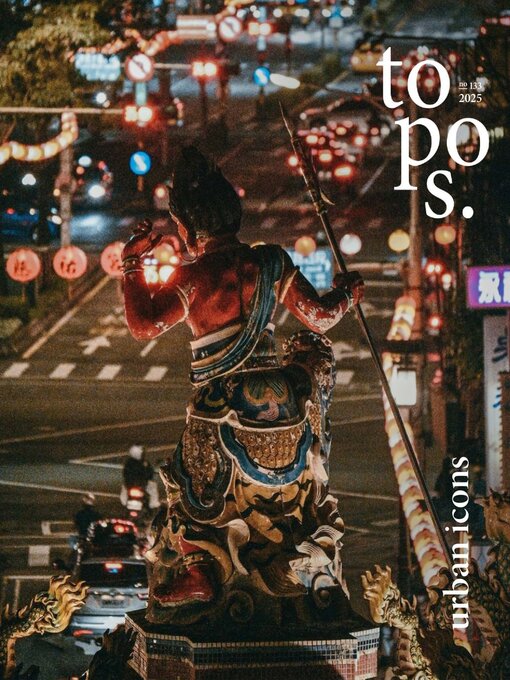
 N. 133
 N. 132
 N. 131
 N. 130
 N. 129
 N. 128
 N. 127
 N. 126
 N. 125
 N. 124
 N. 123
 N. 122
 N. 121
Topos is a must-have for successful landscape architects, planners, urban designers and architects all over the world.The monothematic issues provide a global overview of innovative projects, new developments and trends in the profession. Be part of the worldwide community of Topos readers!
THE INTERNATIONAL REVIEW OF LANDSCAPE ARCHITECTURE AND URBAN DESIGN
EDITORIAL
THE DEATH OF LOCAL • They promised uniqueness – we got repetition. Today’s urban icons, from rooftop gardens to repackaged railways, parade as symbols of identity while quietly standardising our cities. Bold civic gestures have become safe, copy–paste spectacles designed to impress tourists and attract capital. In the race for visibility, cities risk losing their voice – if every city builds its own High Line, who will build something that truly matters?
Where Geometry Meets Growth
Brasília • It was meant to be the capital of the future. Instead, it became the most elegant urban contradiction on Earth. A city drawn like a machine, planted in the wilderness, and polished until it gleamed with modernist faith. Brasília didn’t grow – it landed. Monumental, mathematical, and magnificently indifferent to the mess of daily life. This is not just a city – it’s a diagram. And yet, somehow, it endures. Welcome to the world’s most iconic planning experiment, where utopia got a postal code – and forgot to install pavements.
Frank Gehry
From Monuments to Moments - What Makes an Urban Icon? • When you think of Sydney, the opera house inevitably springs to mind. The thought of Tokyo immediately conjures up images of the bustling Shibuya crossing. The Taj Mahal is symbolic of an entire country in the public perception, just as the Eiffel Tower in Paris is for France or the Statue of Liberty and Central Park are for New York. For various reasons, all of these special places shape the external and, to some extent, the internal perception of the cities they are located in. In architecture and urban research, the term “urban icon” has become established to describe this phenomenon.
THE MIROIR D’EAU IN BORDEAUX • Between the Garonne River and the grand façade of the Place de la Bourse, Bordeaux’s Miroir d’eau unfolds a poetic dialogue between water, architecture, and the public realm. What at first appears as a minimalist surface, becomes a stage where city, sky, and people merge. Conceived by landscape architect Michel Corajoud, the world’s largest reflecting pool embodies a new urban philosophy – one that transforms historic grandeur into a living, participatory experience.
HAMBURG’S NEW URBAN HEART • Where cranes and cargo once defined Hamburg’s harbour, a new kind of city has emerged: HafenCity. Europe’s largest urban regeneration project reclaims former port land and transforms it into a vibrant mixed-use district extending Hamburg’s city centre to the Elbe. Boasting striking architecture, waterfront spaces and the iconic Elbphilharmonie concert hall, HafenCity has become a symbol of urban renewal — an example of how cities can reinvent themselves while remaining true to their maritime heritage.
Roberto Burle Marx and the Copacabana • At Rio’s Copacabana Beach, Roberto Burle Marx transformed the shoreline into a living canvas — a synthesis of art, nature, and social life. His black-and-white promenade embodies both modernity and tradition, turning abstraction into movement and public space into a shared expression of Brazilian identity.
RECLAMATION AND IMAGINATION • What was once a bustling, concrete-covered highway in the heart of Seoul has been transformed into a vibrant urban oasis. The Cheonggyecheon Stream Restoration Project demonstrates how cities can reclaim space for nature, public life, and community, turning infrastructure into a stage for ecological innovation, social interaction, and civic pride.
THE PROMENADE DU...