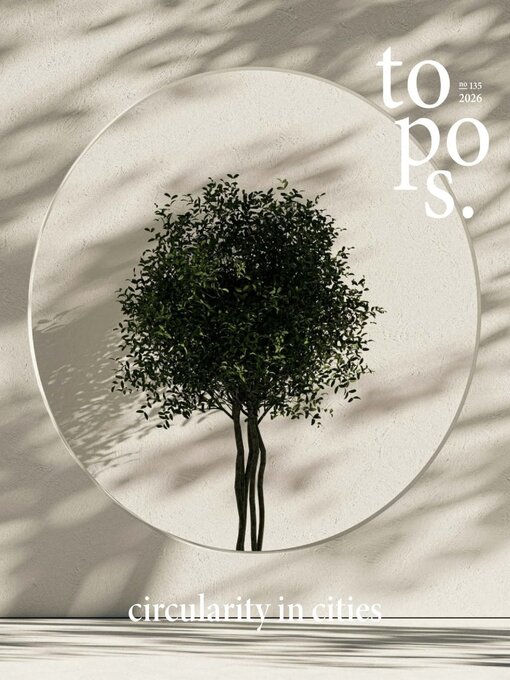
 N. 135
 N. 134
 N. 133
 N. 132
 N. 131
 N. 130
 N. 129
 N. 128
 N. 127
 N. 126
 N. 125
 N. 124
 N. 123
 N. 122
 N. 121
Topos is a must-have for successful landscape architects, planners, urban designers and architects all over the world.The monothematic issues provide a global overview of innovative projects, new developments and trends in the profession. Be part of the worldwide community of Topos readers!
THE INTERNATIONAL REVIEW OF LANDSCAPE ARCHITECTURE AND URBAN DESIGN
Welcome
EUROPE‘S PSEUDO-GREEN LIE • Europe has developed a dangerous talent for confusing moral performance with systemic effectiveness. Nowhere is this more visible than in the climate debate. Entire political careers, urban masterplans and industrial regulations increasingly revolve around emissions symbolism while the actual material realities of the global economy remain stubbornly untouched.
Drowning in Convenience
Curitiba • There are cities that became famous because they were rich, powerful because they industrialised at the right historical moment or admired because they mastered self-promotion. Curitiba belongs to none of these categories. Long before “circularity” became a fashionable term in architecture or urban innovation debates, the Brazilian city had already begun experimenting with something far more difficult than sustainability rhetoric: systemic intelligence.
Kate Raworth
The great miscalculation • Why cities obsessed with carbon accounting are overlooking the far larger tragedy of waste, resource destruction and planned obsolescence.
“DON’T SCALE UP, SPREAD OUT” • During her time as Deputy Mayor for Spatial Development and Sustainability in Amsterdam, Marieke van Doorninck helped integrate circularity into urban policy. In this conversation, she reflects on why the shift beyond pilot projects remains difficult – and why circularity ultimately challenges the very foundations of how cities think about value and growth.
HOLY SHIFT • As congregations shrink and societal needs shift, churches across Europe are entering a new phase of their lifecycle. Rather than disappearing, many are being reimagined– transformed into cultural venues, community hubs, or even spaces for entirely unexpected uses. This evolution is more than a practical response to vacancy; it reflects a broader shift toward circular thinking in architecture. Between preservation and reinvention, the reuse of churches reveals how deeply history, space, and society remain intertwined.
“WE’VE ALREADY MADE SIGNIFICANT PROGRESS” • How can we rethink construction when resources are scarce and climate targets become binding? Dirk Hebel from the Karlsruhe Institute of Technology discusses the role of material cycles, the limits of urban mining and the need to view buildings as long-term reservoirs of raw materials. He highlights how planning, material selection and aesthetics are changing – and what Germany can learn from Ethiopia.
SOCIAL POWER THROUGH SOLAR POWER • In Okahandja Park, an informal settlement on the edge of Windhoek, Namibia’s capital, light spills onto thresholds where formal electricity is absent. What begins as a private energy source extends into shared space and becomes embedded in the everyday life of the settlement.
"MAKING A REPAIR IS OFTEN THE STARTING POINT OF A MINDSET SHIFT" • Martine Postma has turned repair into a global civic practice. With the Repair Café movement, she has helped transform everyday objects – and how people relate to them– into a starting point for circular thinking in cities worldwide. She explains how community-based repair initiatives contribute to urban circularity not only through technology or infrastructure, but through shared skills, social engagement, and a broader cultural transformation in how people see consumption and ownership.
THE FUTURE HUMS • What ends up as waste today will become a valuable resource tomorrow. Insects convert organic waste into high-quality...